Content Menu
● What “Sneaker Replica” Means in This Guide
● Selection Criteria: How Buyers Should Assess a Supplier
>> Factory Identity Comes Before Factory Claims
>> Development Capability Must Be Demonstrated
>> Certificates Must Match the Actual Production Site
● Why China Remains Relevant for Sneaker Sourcing
● Supplier Comparison: Capacity, MOQ, and Certification Evidence
● The Top 10 Sourcing Candidates
>> 1. Luxurry Edit — A Buyer-Supplied Candidate for Detail-Focused Sourcing
>> 2. DOING SHOES — A Clearly Disclosed Factory-and-Partner Model
>> 3. WIDEWAY — An Athletic Footwear Candidate With Detailed Technical Claims
>> 4. DADAO — A Candidate for Structured Sneaker Development
>> 5. Luck Shoe — A Larger-Volume OEM/ODM Option
>> 6. UM Footwear — A Multi-Location Development Candidate
>> 7. Joes Footwear — A Development Partner for Broader Fashion Collections
>> 8. Fuzhou HEVA Shoes — A Candidate for EVA and Mixed Footwear Programs
>> 9. XINZIRAIN — A Custom Fashion-Footwear Candidate
>> 10. China Shoe Factory / footwear-shoes.com — A Low-MOQ Prospect Requiring Identity Checks
● Technical Buyer’s Guide: What Quality Specifications Should Cover
>> Replace Material Labels With Measurable Requirements
>> Separate Appearance Approval From Performance Approval
>> CE and RoHS Are Not General Sneaker Quality Certificates
● Common Procurement Problems and How to Reduce Them
>> Material Substitution After Sample Approval
>> Unusable Certification Evidence
● An Overlooked Procurement Trap: Sample Approval Is Not Production Approval
● Samples, Logistics, and Commercial Terms
>> Use a Stage-Gated Sample Process
>> Build a Realistic Delivery Schedule
>> Make the Logistics Scope Explicit
● Select a Production System, Not a Photograph
● FAQs
>> 1. How can I verify whether a supplier’s ISO certificate has expired?
>> 2. Can I approve a whole size range using one sample size?
>> 3. Does certified material sourcing mean the finished sneaker is certified?
>> 4. What should happen when a supplier’s published MOQ or capacity figures conflict?
>> 5. Does an OEM contract or NDA establish permission to reproduce a branded sneaker?
Finding a dependable supplier requires more than comparing product photographs or asking which factory offers the closest visual match. For professional buyers searching for “Sneaker Replica manufacturers in China,” the real procurement questions concern material consistency, development capability, manufacturing accountability, delivery reliability, and the right to produce and sell the proposed design.
China remains a major footwear manufacturing base. The World Footwear Yearbook 2025, published by the Portuguese footwear association APICCAPS, reports that global footwear production reached 23.9 billion pairs in 2024, up 6.9% from the previous year. China produced approximately 13 billion pairs, representing around 54% of global output. These figures describe the footwear industry overall—not a separately measured replica-sneaker market.
However, manufacturing scale alone does not identify the right long-term partner. A large factory may be unsuitable for a small collection, while a responsive development partner may outsource production and require additional oversight.
This guide compares ten sourcing candidates, explains what their public information actually supports, and identifies the documents buyers should request before approving an order.
What “Sneaker Replica” Means in This Guide
The search term “Sneaker Replica” can describe different commercial intentions: authorized reproductions, reference-based product development, private-label alternatives, or unauthorized copies of branded footwear.
These categories should not be treated as interchangeable.
For this guide, the procurement focus is authorized reproduction and original OEM/ODM development. A supplier’s ability to manufacture a similar silhouette does not establish permission to reproduce another company’s branding or protected design features. Buyers should obtain appropriate rights clearance before commissioning production.
The companies below are therefore sourcing candidates rather than verified manufacturers of unauthorized branded replicas. Their inclusion does not establish brand authorization, legal clearance, or independently confirmed manufacturing performance.
Selection Criteria: How Buyers Should Assess a Supplier
A useful shortlist should make its evaluation method visible. The following framework prioritizes evidence over promotional language.
| Evaluation area | Suggested weighting | Evidence to request |
|---|---|---|
| Product development and engineering | 25% | Technical packs, last-development records, tooling proposals, sample revision history |
| Quality control and traceability | 25% | Inspection procedures, material specifications, batch records, corrective-action reports |
| Production planning and delivery | 20% | Factory-specific capacity, production schedule, subcontractor disclosure |
| Compliance and rights documentation | 20% | Current certificates, relevant test reports, design authorization where necessary |
| Commercial communication | 10% | Itemized quotation, documented response process, change-control procedure |
These weights are a proposed purchasing framework, not scores awarded to the companies in this article. No supplier has been independently audited for this guide.
Factory Identity Comes Before Factory Claims
Start by establishing who will sign the contract, receive payment, manufacture the shoes, and appear on export documents.
A factory-owned operation, a trading company, and a managed manufacturing network can all serve buyers effectively. The important distinction is accountability: the buyer should know which site will produce each order and whether subcontracting requires approval.
Development Capability Must Be Demonstrated
Ask prospective suppliers to explain how they handle:
- Last selection and size grading.
- Upper patterns and reinforcement placement.
- Outsole selection or custom tooling.
- Material sourcing and substitution control.
- Fit testing and sample revisions.
- Pre-production approval and bulk-production transfer.
A statement such as “full OEM support” is less useful than a clear development plan showing deliverables, costs, responsibilities, and approval stages.
Certificates Must Match the Actual Production Site
A certificate should be checked against the legal entity, factory address, applicable standard, scope, and current status. IAF CertSearch provides verification of accredited management-system certificates and displays information including status, scope, issuing body, and accreditation details.
A certificate belonging to a different group company or an unrelated facility should not automatically be accepted as evidence for the factory producing your order.
Why China Remains Relevant for Sneaker Sourcing
China’s advantage is not simply production volume. Supplier profiles show distinct manufacturing locations and business models across footwear hubs.
Jinjiang and Quanzhou in Fujian feature prominently among athletic and casual footwear suppliers. DADAO, DOING SHOES, and WIDEWAY all identify operations in this region. Dongguan’s Houjie area is represented by Joes Footwear and another private-label shoe supplier, while Sichuan is represented by Luck Shoe and XINZIRAIN.
For buyers, the practical question is how a supplier uses its location. Ask whether the sample room, outsole source, upper-production workshop, and final assembly site are nearby or distributed across several regions.
Do not assume that a sales office address identifies the manufacturing location. Request the production-site address separately.
Supplier Comparison: Capacity, MOQ, and Certification Evidence
The table below separates published supplier claims from information that remains unavailable. “Not established” means the reviewed material did not provide sufficient evidence; it does not mean the supplier lacks the capability.
| Supplier | Establishment information | Published production scale | Published MOQ | Certification or audit information |
|---|---|---|---|---|
| Luxurry Edit | Year not supplied | Not independently established | Request quotation | Not independently established |
| DOING SHOES | Factory established in 2002 | Claims 200,000+ pairs/month at its own factory | Company facts page states 1,200 pairs/style | Claims amfori BSCI and HBI audits |
| WIDEWAY | States established in 2007 | Publishes 300,000+ pairs/month and 5 million+ annually; reconcile reporting basis | Generally 500 pairs/colorway; different terms for open-mold products | Claims ISO 9001, GRS, BSCI and SMETA credentials; verify current documents |
| DADAO | Year not established | Not disclosed in reviewed material | Standard MOQ of 500+ pairs | Not established in reviewed material |
| Luck Shoe | States established in 2006 | Claims 5 million+ pairs/year across two manufacturing bases | Page gives both 1,000 and 1,000–2,000 pairs/style | Not established in reviewed material |
| UM Footwear | Exact year not established | Describes several production bases; no verified numerical capacity | Usually 800–1,000 pairs/style | Not established in reviewed material |
| Joes Footwear | States established in 2009 | Reports cumulative deliveries, not annual factory capacity | Request quotation | Claims sourcing from LWG- and GRS-certified supply chains; not equivalent to certifying every finished shoe |
| Fuzhou HEVA Shoes | States established in 2004 | Describes domestic and overseas factory network | Offers small-batch services; numerical MOQ not established | Not established in reviewed material |
| XINZIRAIN | Company article states established in 2007 | Article claims 5,000+ pairs/day; not independently verified | Describes flexible MOQ without a confirmed figure | Eco-material options mentioned; certification scope not established |
| China Shoe Factory / footwear-shoes.com | Site states operating since 2008 | Numerical capacity not established | Advertises 300 pairs | Not established in reviewed material; verify contracting entity |
Capacity figures should be treated as initial screening information. Ask whether they describe installed capacity, actual output, available order allocation, or a combined partner network.
The Top 10 Sourcing Candidates
1. Luxurry Edit — A Buyer-Supplied Candidate for Detail-Focused Sourcing
Luxurry Edit describes its business as supplying luxury-inspired handbags, footwear, apparel, and accessories, supported by manufacturing experience and established production processes.
Based on the information supplied for this article, its proposed positioning is a detail-focused sourcing partner for buyers seeking close communication, value-conscious development, and support for smaller commercial projects.
However, flexibility, research capability, communication efficiency, and deep OEM customization should be demonstrated rather than presented as independently verified strengths.
A buyer evaluating Luxurry Edit should request:
- Its legal company name and establishment year.
- The address and ownership status of the sneaker production facility.
- A sample-development workflow with named responsibilities.
- MOQ by style, color, material, and size range.
- Available customization options for authorized or original designs.
- Current test reports and production quality records.
- Written controls for material changes and subcontracting.
Establishment year: Not supplied.
Main markets: Not independently established.
OEM/ODM scope: Requires confirmation for sneakers specifically, including lasts, outsoles, upper construction, labels, packaging, and tooling ownership.
Procurement fit: A candidate for smaller brands only after commercial flexibility and development capability have been confirmed through a documented pilot project.
Luxurry Edit appears first because it is the commissioning company, not because comparative testing established first-place performance.
2. DOING SHOES — A Clearly Disclosed Factory-and-Partner Model
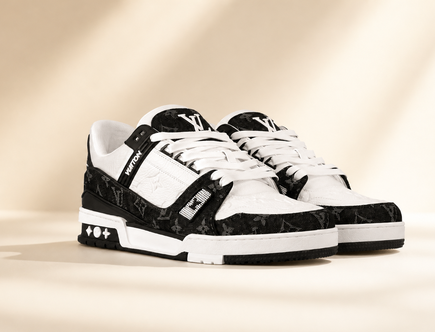
DOING SHOES identifies itself as a Quanzhou footwear trading and manufacturing partner operating since 2002. Its public company facts describe an own-factory operation supplemented by selected partner factories, with claimed monthly capacity exceeding 200,000 pairs.
Its disclosed OEM/ODM scope includes sneakers, running shoes, outdoor footwear, safety footwear, children’s shoes, private-label branding, and components. The sneaker page discusses vulcanized, cemented, and injection constructions, custom lasts, and tooling development.
Establishment year: 2002, according to the company.
Main markets: International brands, importers, and wholesalers; a verified regional revenue breakdown was not established.
Core advantage: Its public description distinguishes its own factory from its partner network.
Buyer caution: Published MOQ information differs between pages. The company facts page states 1,200 pairs per style, while the sneaker page contains other figures. Obtain one signed, project-specific MOQ schedule before budgeting.
3. WIDEWAY — An Athletic Footwear Candidate With Detailed Technical Claims
WIDEWAY states that it was established in Jinjiang in 2007 and specializes in sneakers, athletic footwear, casual shoes, slides, and sandals. Its website describes custom lasts, outsole molds, labels, heel components, and retail packaging.
The company publishes detailed testing claims covering flex resistance, abrasion, and sole bonding. It also lists several management-system and social-audit credentials. These are useful starting points for document requests, but the website alone does not independently validate them.
Establishment year: 2007, according to the company.
Main markets: The site lists North America, Europe, Latin America, Southeast Asia, and the Middle East.
Core advantage: A relatively detailed description of tooling and private-label development services.
Buyer caution: Request the actual test methods, laboratory reports, certificate numbers, and production-site scope. Also reconcile monthly and annual capacity claims before assigning volume.
4. DADAO — A Candidate for Structured Sneaker Development
DADAO identifies a Jinjiang location and promotes OEM/ODM development for business sneakers, casual footwear, athletic shoes, and winter boots. Its published development approach discusses upper materials, shoe structure, lasts, outsole tooling, and commercial requirements.
Its standard MOQ is stated as 500+ pairs, making it worth considering for buyers whose initial volumes are below the thresholds advertised by some larger suppliers.
Establishment year: Not established in the reviewed material.
Main markets: International brands and distributors are described; specific principal markets remain unconfirmed.
OEM/ODM scope: Design validation, material selection, prototype development, and production support.
Core advantage: Its public development description addresses several engineering decisions beyond appearance.
Buyer caution: Confirm legal identity, factory ownership, available capacity, testing capability, and whether the MOQ applies per style or color.
5. Luck Shoe — A Larger-Volume OEM/ODM Option
Luck Shoe states that it was established in 2006 and operates two manufacturing bases with a combined factory area of 30,000 square meters and annual capacity exceeding five million pairs. These are supplier-published figures.
Its product scope includes running shoes, outdoor footwear, casual sneakers, and lifestyle footwear. The company describes concept development, sampling, and bulk-production support for brands, wholesalers, retailers, and importers.
Establishment year: 2006, according to the company.
Main markets: International commercial buyers; principal destination markets were not established.
Core advantage: A stated multi-base operation with substantial claimed production scale.
Buyer caution: The page uses different MOQ formulations. Confirm the applicable quantity, color split, production site, tooling requirements, and available—not merely installed—capacity.
6. UM Footwear — A Multi-Location Development Candidate
UM Footwear describes production bases in Fujian, Jiangxi, and Yunnan, with OEM/ODM services covering sneakers, casual footwear, outdoor shoes, and children’s collections. Its published MOQ usually starts at 800–1,000 pairs per style.
Establishment year: Not established. The reviewed page uses experience claims rather than a clearly verified founding date.
Main markets: Global brands are mentioned; principal export destinations remain unconfirmed.
Core advantage: Broad category coverage and a described multi-location production network.
OEM/ODM scope: Design development through manufacturing and delivery.
Buyer caution: Obtain site-specific documentation. A report or certificate from one production base should not automatically be accepted for an order manufactured elsewhere.
7. Joes Footwear — A Development Partner for Broader Fashion Collections
Joes Footwear states that it was established in 2009 and operates a managed network of specialized production facilities. Its services include design, CAD development, sourcing, fitting, quality control, and shipping.
The company’s wider product offering includes women’s and men’s footwear, sneakers, and bags. This may suit brands developing coordinated fashion collections rather than a narrowly focused athletic program.
Establishment year: 2009, according to the company.
Main markets: The website reports shipments to more than 30 countries without establishing a principal-market breakdown.
Core advantage: Development coordination across footwear and accessory categories.
OEM/ODM scope: Technical packs, design translation, material sourcing, prototyping, and production management.
Buyer caution: Its “500,000+ pairs delivered” statement is cumulative, not annual capacity. Its LWG and GRS sourcing claims also require material- and order-specific evidence.
8. Fuzhou HEVA Shoes — A Candidate for EVA and Mixed Footwear Programs
Fuzhou HEVA Shoes states that it was established in 2004. Its company article describes EVA injection-molding expertise and products including water shoes, sandals, sneakers, boots, and children’s footwear.
The same article describes domestic and overseas manufacturing locations, as well as OEM/ODM, ready-stock, and small-batch services.
Establishment year: 2004, according to the company.
Main markets: International operations are described, but overseas offices should not be treated as proof of sales concentration.
Core advantage: EVA-related production capability and category breadth.
OEM/ODM scope: Design, manufacturing, wholesale supply, and customization.
Buyer caution: Confirm which site will produce the sneaker order and whether the proposed construction matches that site’s demonstrated capability.
9. XINZIRAIN — A Custom Fashion-Footwear Candidate
A company-published article describes XINZIRAIN as a Chengdu custom-footwear business established in 2007, with products including sneakers, heels, sandals, and boots. It promotes OEM/ODM services, prototyping, flexible minimums, and eco-material options.
Establishment year: 2007, according to the company article.
Main markets: Global clients are mentioned; a verified destination-market breakdown was not established.
Core advantage: Potential suitability for brands combining sneaker development with broader fashion footwear.
OEM/ODM scope: Custom footwear development and production.
Buyer caution: Request numeric MOQ terms and construction-specific production evidence. Broad fashion-footwear experience should not substitute for testing the exact sneaker design being ordered.
10. China Shoe Factory / footwear-shoes.com — A Low-MOQ Prospect Requiring Identity Checks
The website footwear-shoes.com advertises OEM, ODM, and private-label manufacturing from Houjie, Dongguan, and states that operations date to 2008. It publishes a 300-pair MOQ, sampling of 7–15 days, and bulk delivery of 25–35 days.
Establishment year: 2008, according to the website.
Main markets: The site claims exports to more than 60 countries but does not establish the main destinations.
Core advantage: Published low-MOQ terms and a broad footwear offering.
OEM/ODM scope: Custom designs, materials, colors, and branding.
Buyer caution: The generic trading name makes legal-entity verification especially important. Confirm the registered company, bank beneficiary, factory address, and whether the advertised lead times apply to custom tooling or existing styles.
Technical Buyer’s Guide: What Quality Specifications Should Cover
Replace Material Labels With Measurable Requirements
Terms such as “premium leather,” “original-grade material,” and “high-density foam” are not complete purchasing specifications.
A technical pack should identify:
- Upper material composition, thickness, finish, and approved source.
- Lining construction and reinforcement locations.
- Midsole material, density, hardness, and required performance.
- Outsole compound and applicable durability testing.
- Insole construction and thickness.
- Thread, seam allowance, stitch requirements, and tolerances.
- Color references and approval conditions.
- Packaging, labels, and traceability requirements.
The goal is to make substitutions visible and approval-dependent.
Separate Appearance Approval From Performance Approval
A visually convincing sample does not establish durability or fit across a production size range.
Ask the laboratory and supplier to propose a test plan appropriate to the construction and intended use. Relevant topics may include sole adhesion, flex resistance, abrasion, color transfer, fit consistency, and material aging.
Avoid adopting a supplier’s published test threshold without also confirming the method, conditioning procedure, specimen location, and pass/fail interpretation. WIDEWAY’s detailed public testing claims illustrate why buyers should request the underlying reports rather than relying on headline numbers.
CE and RoHS Are Not General Sneaker Quality Certificates
Verification is especially important when suppliers advertise “CE-approved sneakers.”
The European Commission states that CE marking applies only to products covered by legislation that specifically requires it; it must not be applied to products outside that scope. Ordinary fashion sneakers should therefore not be assessed using CE claims as a general quality benchmark. Protective footwear requires a separate assessment of applicable rules.
RoHS concerns electrical and electronic equipment rather than serving as a general environmental certification for conventional footwear. Products incorporating electronics require a separate applicability review.
For leather and textile footwear, chemical requirements need product-specific assessment. ECHA materials identify relevant concerns involving chromium VI in leather and restrictions concerning certain azo dyes and substances in clothing, related accessories, and footwear.
Common Procurement Problems and How to Reduce Them
Material Substitution After Sample Approval
A supplier may offer an attractive sample without providing enough detail to establish what must be used in bulk production.
Reduce this risk by approving a bill of materials, retaining labeled material swatches, and requiring written approval for substitutions. Tie material identities to inspection and purchasing records.
Unclear Factory Allocation
A quotation may describe company-wide capability while the order is assigned to an undisclosed partner.
Require the production address in the purchase order, identify subcontracted processes, and reserve inspection access to the actual manufacturing site.
MOQ Ambiguity
“500 pairs MOQ” is incomplete if it does not specify whether the minimum applies per style, color, material, outsole, or size assortment.
Request a MOQ matrix and a separate list of tooling, material, and packaging minimums. Published inconsistencies on supplier pages make written clarification particularly important.
Unusable Certification Evidence
A certificate logo does not reveal validity, scope, or location.
Request the complete document and verify accredited management-system credentials through IAF CertSearch and, when necessary, the issuing certification body.
An Overlooked Procurement Trap: Sample Approval Is Not Production Approval
One useful safeguard is to treat showroom samples, development samples, pre-production samples, and bulk-production samples as different approval stages.
A sample made by a development technician may demonstrate that the design is achievable. It does not, by itself, prove that the assigned production line will reproduce it consistently.
For a more reliable approval process:
- Approve the design and material specification.
- Freeze the bill of materials and revision number.
- Identify the production site and intended construction process.
- Approve a pre-production sample using the intended materials.
- Review representative sizes rather than only the base size.
- Inspect pairs drawn from the production run.
- Record deviations and corrective actions before shipment.
This is a recommended purchasing control, not a claim that any listed supplier engages in sample manipulation.
Samples, Logistics, and Commercial Terms
Use a Stage-Gated Sample Process
For a new sneaker project, agree on four deliverables:
- Development sample: establishes construction feasibility.
- Fit and size-set samples: evaluate sizing and grading.
- Pre-production sample: freezes materials and details.
- Production inspection sample: checks execution against approval.
Record the revision number and approval status for each stage. Avoid using informal chat messages as the only specification record.
Build a Realistic Delivery Schedule
Ask the supplier to separate material procurement, tooling, sample revision, manufacturing, inspection, packing, and shipping milestones.
A published “30-day production” promise may exclude development and tooling. Treat supplier-advertised timing as a starting point, not a confirmed arrival date.
Make the Logistics Scope Explicit
Before shipment, clarify:
- Named delivery term and location.
- Responsibility for freight, insurance, clearance, duties, and taxes.
- Importer-of-record arrangements.
- Product descriptions and shipping documentation.
- Carton dimensions and gross weight.
- Inspection release requirements.
- Responsibility for delays, damage, and nonconforming goods.
Use a qualified customs or logistics professional to confirm destination-specific obligations. Do not treat a supplier’s shipping offer as evidence that product rights or market-access requirements have been resolved.
Select a Production System, Not a Photograph
The strongest sourcing decision connects design feasibility, documented materials, factory accountability, current compliance evidence, and realistic commercial terms.
This shortlist provides different starting points: athletic-footwear manufacturers, managed production networks, fashion-development partners, and lower-MOQ prospects. It does not establish that every supplier offers the same capability—or that any supplier has authorization to reproduce a third-party branded product.
For buyers considering Luxurry Edit, the next step should be a documented feasibility review. Submit an authorized design brief or original technical pack and request a written proposal covering materials, customization, MOQ, sampling stages, production allocation, testing, and delivery assumptions.
A successful pilot order should demonstrate repeatability before a buyer commits to a larger seasonal program.
FAQs
1. How can I verify whether a supplier’s ISO certificate has expired?
Search the certificate number or company name in IAF CertSearch. Review the status, scope, issuing body, and listed locations—not just the expiry date printed on a PDF. If information is missing or inconsistent, contact the issuing certification body directly before accepting the document.
2. Can I approve a whole size range using one sample size?
Do not rely on a single base-size sample for a complex new development. Request representative size-set samples and assess fit, grading, component alignment, and construction consistency. Define the approval scope in writing so a base-size approval is not interpreted as approval of every size.
3. Does certified material sourcing mean the finished sneaker is certified?
Not automatically. A claim involving an LWG- or GRS-certified supply chain needs to be checked against the material, supplier, production site, and proposed product claim. Joes Footwear’s published sourcing statement, for example, should not be read as certification of every finished shoe it supplies.
4. What should happen when a supplier’s published MOQ or capacity figures conflict?
Request one dated, project-specific quotation from the contracting entity. It should state the MOQ basis, color allocation, assigned factory, available capacity, sample schedule, and tooling costs. DOING SHOES and Luck Shoe provide examples of why website figures should not be treated as final commercial terms.
5. Does an OEM contract or NDA establish permission to reproduce a branded sneaker?
No such permission is established merely by signing a manufacturing or confidentiality agreement. Require separate evidence of the relevant rights and obtain a qualified review where necessary. Keep rights documentation distinct from quality certificates, factory audits, and shipping arrangements.
References
1. APICCAPS / World Footwear Yearbook 2025 — official industry report, including global production and trade context: https://www.worldfootwear.com/media/wf_uploads/wf202531587451624.pdf
2. European Union business guidance — CE marking applicability: https://europa.eu/youreurope/business/product-rules-compliance/general-product-compliance/ce-marking/index_en.htm
3. European Commission — CE marking overview: https://single-market-economy.ec.europa.eu/single-market/goods/ce-marking_en
4. European Chemicals Agency — chromium VI in leather background document: https://echa.europa.eu/documents/10162/8ff2f208-c6a7-4ab8-8573-4100ac8214df
5. IAF CertSearch — accredited certificate verification: https://www.iafcertsearch.org/
Hot Tags: Sneaker Replica, Sneaker Replica Manufacturers in China, China Sneaker Manufacturers, OEM Sneaker Manufacturing, ODM Footwear Suppliers, Private Label Sneakers, Custom Sneaker Development, Footwear Factory Verification, Sneaker Quality Control, Authorized Footwear Reproduction